NCAA Academic Eligibility: Where Does Your Athlete Actually Stand Right Now?
Here is a truth that does not get said enough in recruiting circles.
A student-athlete can be the most recruited player in their class, with the highlight film, the coach relationships, and the scholarship conversations, and still be ruled ineligible to compete in college because their academic record did not meet NCAA standards.
It happens. More often than it should. And in almost every case, it was preventable.
NCAA academic eligibility is not something you fix senior year. It is built or missed starting in 9th grade. Every year matters. Every course matters. And summer is one of the last real opportunities your family has to catch up if you are behind.
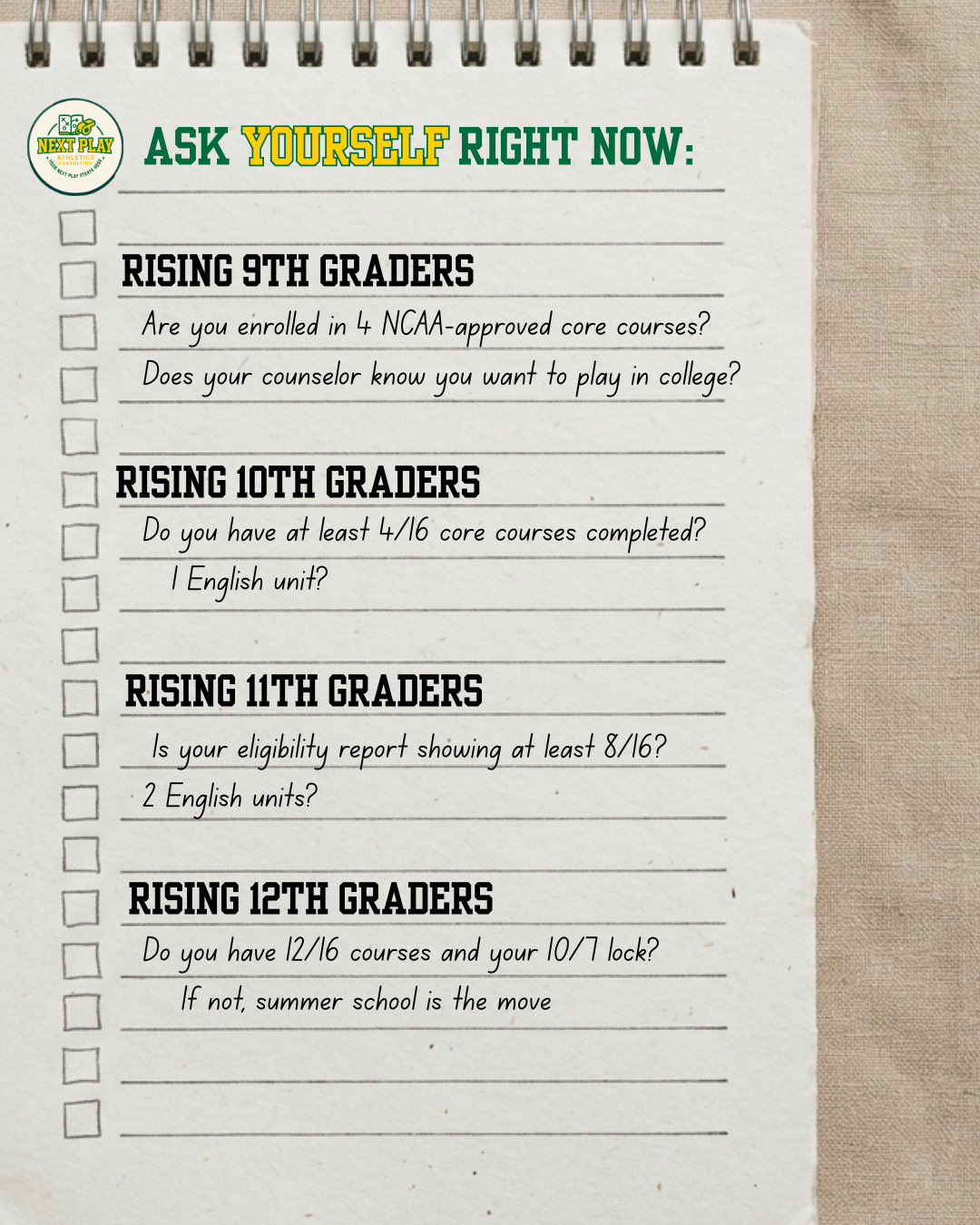
Today we are going to break down exactly where your athlete should stand at each grade level heading into this summer and what to do if they are not there yet.
how the ncaa core course requirement works
To be eligible to compete at the Division I or Division II level, your athlete must complete 16 core courses in specific subject areas including English, math, natural or physical science, social science, foreign language, comparative religion, or philosophy.
Not every course on a high school transcript qualifies. Remedial courses, physical education, and certain electives do not count. The courses that do count must be on your school's NCAA-approved course list, which your counselor can confirm.
Beyond completing 16 core courses, athletes must also meet minimum GPA and standardized test score requirements that are evaluated together on a sliding scale. But the course count is foundational. Without 16 approved courses completed by graduation, none of the rest matters.
Here is where your athlete should be at each grade level right now.
rising 9th graders: build the foundation
If your athlete is heading into freshman year, you are in the best possible position. Nothing is broken. But right now, before school starts, is the time to set the foundation correctly.
Make sure your athlete is enrolled in at least 4 NCAA-approved core courses for their freshman year. Talk to your school counselor and make sure they know your athlete's goal is to play college sports. Ask whether any 8th grade courses completed at the high school level can count toward the 16-course requirement.
This conversation with your counselor is more important than most families realize. A counselor who understands the recruiting goal will map out a four-year academic plan that protects eligibility at every step. A counselor who does not know will build a schedule around graduation requirements alone, and those two things are not always the same.
If you have not registered with the NCAA Eligibility Center yet, do it now. It is free and it is where college coaches go to verify eligibility.
Summer action: Have the counselor meeting. Get the four-year plan on paper before freshman year starts.Register for a NCAA Eligibility Profile Account (Free).
rising 10th graders: check your progress
Heading into sophomore year, your athlete should have at least 4 of the 16 required core courses completed, including at least 1 full English unit.
Transition your Eligibility profile account to a certification account. If your desires are to play D1 or DII, get the Academic & Amateurism certification account.
If your athlete is behind on core courses, this summer is an opportunity to pick up an NCAA-approved course through summer school or an accredited online provider before sophomore year begins.
Summer action: Transition your profile account to the correct account based on your athletic desires. Add a core course this summer if you are behind.
rising 11th graders: this is the most important summer
Junior year is when recruiting conversations get real. Coaches are evaluating rosters, making offers, and building the class they will sign. If your athlete's eligibility is shaky heading into 11th grade, it will come up and it will cost them.
Heading into junior year, your athlete should have at least 8 of 16 core courses completed with at least 2 full English units. But more importantly, you need to be building toward what is called the 10/7 lock.
The 10/7 lock is a Division I requirement that says by the start of senior year, your athlete must have completed 10 of their 16 required core courses, with at least 7 of those 10 coming from English, math, or natural or physical science. Once senior year starts, you cannot go back and change this. If you miss the 10/7 lock, certain eligibility paths are permanently closed unless you transfer once you satisfy one semester at a college.
This makes the summer before junior year one of the most critical academic windows in the entire process.
Summer action: Count your current core courses and identify the gap to 10/7. If you need to double up on English or science, plan for it now through summer coursework or your junior year schedule.
rising 12th graders: lock it in
If your athlete is heading into senior year, the goal is straightforward. You need 12 of 16 core courses completed with at least 3 English units, and the 10/7 lock secured before school starts.
If the 10/7 lock is not in place, this is a serious conversation you need to have with your counselor immediately. Depending on where your athlete stands, summer school may be the path forward. It is not ideal, but it is far better than finding out in October that a scholarship offer is in jeopardy because the eligibility certification will not be cleared.
Also this summer: if your athlete has not uploaded their official transcript to the NCAA Eligibility Center, do it now. Coaches at Division I and Division II schools cannot process an official scholarship offer without eligibility certification in place.
Summer action: Confirm the 10/7 lock is met. Upload transcripts to the NCAA Eligibility Center. Request your final eligibility certification early and do not wait until the fall.
the bottom line
The recruiting work you are doing this summer, the coach emails, the showcases, the highlight films, is all built on the foundation of academic eligibility. None of it matters if the eligibility is not there.
The good news is that for most families reading this, there is still time to fix it. But time is the one thing you cannot get back in this process. If your athlete is behind, act now.
Tomorrow we are talking about the college application process for recruits, which is different from the standard process in ways that catch most families completely off guard.
Follow NextPlay Athletics on Instagram and Facebook so you do not miss Day 4.👉 nextplayathletics_